Most voice over for commercials sounds like voice over for commercials. That’s the problem.
You’ve heard it. The voice that’s doing the thing voices do in commercials. The push on key words. The brightness. The confidence that’s just slightly too much. The listen-to-me-I’m-important cadence. Your brain recognizes it as an advertisement before the first sentence is finished, and you’re already somewhere else.
That’s not the voice over failing. That’s the voice over doing exactly what bad direction produces. The talent delivered what they thought was wanted. The problem is what was wanted.
What agencies are actually booking now is different. And the difference is worth understanding if you’re in the market for commercial voice work.
What the Commercial Voice Over Market Shifted To
The announcer voice had a long run. It worked when radio and TV were the only game and the audience had no choice but to sit through the ad. That era is over.
Listeners now have skip buttons, ad blockers, playlists, and about half a second of patience before they’re gone. The voice that sounds like it’s performing a commercial gets tuned out faster than silence. The voice that sounds like a real person talking gets heard.
Conversational commercial voice over has been the dominant booking trend for the better part of a decade now. That doesn’t mean casual or low-energy. It means the listener can’t hear the performance. They just hear the message.
That’s a harder thing to do than it sounds.
The Question Most Commercial VO Artists Never Ask
When I prep a commercial script, I’m not thinking about the client. I’m not even thinking about the agency. I’m thinking about one specific person: the listener.
Not the listener in general. The listener who’s going to hear this specific spot. Where are they? Are they driving? Watching a YouTube video before the skip button unlocks? Half-asleep on a Sunday morning with the TV on? The physical setting changes everything about the tone of a read.
My teacher at my first voice over class said something I’ve thought about ever since: when you’re doing a voice over, you’re not talking to the client. You’re talking directly to the client’s customer. Two layers of audience awareness. Most VO artists stop at one.
If I’m recording a spot for a hardware store, I’m not talking to the hardware store. I’m talking to the guy who’s been putting off the deck project for two summers. I know that guy. I can talk to him. Not at him. To him.
That’s the connection that makes a commercial work or not work.
Why “Authentic” Isn’t Just a Buzzword
Every agency brief has the word “authentic” in it now. I understand why that word has lost some meaning. It gets written on briefs and nobody defines it and then they end up with a polished-to-death read that still sounds like an ad.
Here’s what authentic actually means in a commercial read: the listener can’t detect the performance.
When a read lands, listeners can’t tell you exactly why they believed it. They just did. What they were actually picking up on was the absence of theater. Someone was genuinely talking to them rather than at them. Something in the brain registers that as safe. As trustworthy. As worth a few more seconds.
You can’t fake your way to that. You either have enough real experience behind the mic to make a read feel like conversation, or you don’t. There’s no technique that gets you there faster than the hours it takes to develop.
What I Bring to Commercial Work
I’ve been in front of a microphone since 1996. Commercial radio, local TV, national spots. The early years were all live broadcast, which wires a kind of presence into you that studio work alone doesn’t build. You don’t get retakes on live. You get one run. That trains you to be clean and committed on take one.
My home base is rural Illinois. I’m not approximating the Midwestern audience that most national commercials are aimed at. I wake up in it. The guy who buys trucks, brews his own beer, drives an hour to the hardware store because that’s just how far things are. I don’t have to find him. I am him.
That’s what I mean when I say the voice has to match the audience. For a lot of commercial copy, my life is the credential.
What to Expect When You Work With Me
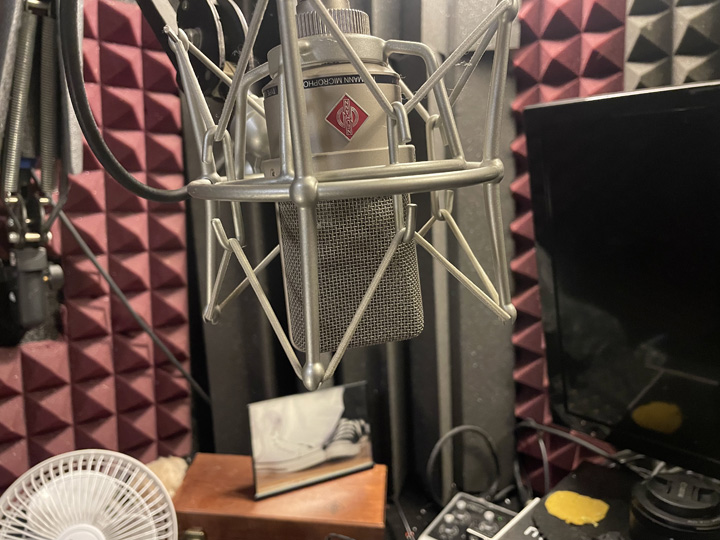
Scripts come in, I read them the same day. Standard delivery is 24-48 hours, often faster for shorter spots. I record in a Whisper Room isolation booth with a Neumann TLM 103. The audio is clean and production-ready. Pickups and revisions happen fast.
I’ve worked with agencies and production houses across the country. The process is simple: you send the script, I send the read. If something needs adjusting, we adjust it. No drama.
The quickest way to know if my voice is right for your project is to listen to the demos. That tells you more than anything I could write here.
Hear the commercial demos and see if the fit is there.
Industry Context
The GVAA rate guide is the industry standard for understanding what professional commercial VO work pays. For an overview of how broadcast audio production has shifted, the IAB Audio Ad Revenue Report tracks where commercial audio spend is moving.