The question of AI voice over vs human voice over comes up constantly now, so let me give you my honest take as someone whose livelihood depends on the answer. I do. It’s just not the opinion you’d expect.
AI voice has gotten technically impressive. If you handed me a blind listening test three years ago, I could spot AI in the first ten seconds. Today that gap has narrowed. The artifacts are cleaner. The pacing is more natural. The rhythm isn’t obviously robotic anymore.
So the argument “AI sounds fake, hire a human” is getting weaker, and people in my position who are still making that argument haven’t listened to what AI can do in 2026.
That said, here’s what I actually think, and why it matters for your project.
Where AI Voice Over Works Fine
Internal content. Low-stakes notifications. Rapid-prototype explainers that will be replaced in a month. Content where the voice is purely functional, where no one is making a decision based on how it sounds, where the only requirement is that the words be intelligible.
If you’re producing content that no one will watch except to check a box, AI is a reasonable tool. The economics work. The output is enough.
Where It Doesn’t
Anywhere that belief matters.
That sounds abstract. Here’s what it means in practice. When you’re watching a commercial, an interview, a brand film, a customer testimonial, part of your brain is running a constant authenticity check. Is this person real? Do they mean it? Should I trust what they’re telling me?
AI passes the technical test. It sounds like speech. It doesn’t pass the human test, at least not yet. Not because of how it sounds, but because of what it doesn’t know it should do.
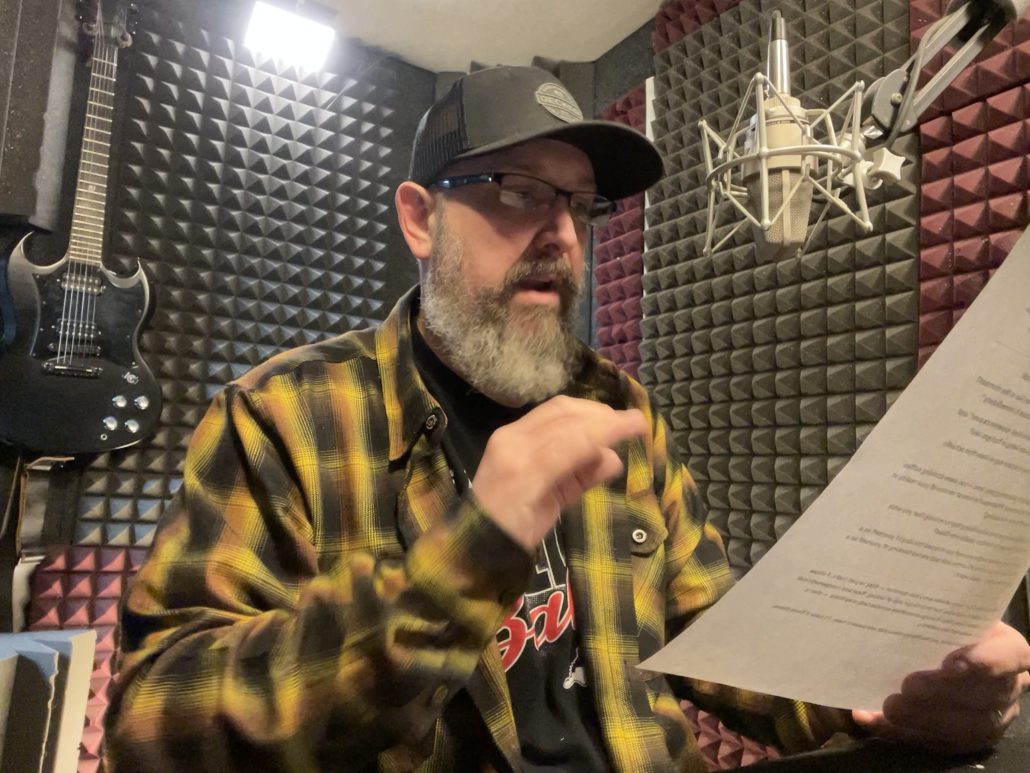
A human voice actor with 30 years of experience reads a script and makes dozens of micro-decisions the director never asked for. The slight lean into a specific word. The breath before the important sentence. The pause that isn’t in the script but has to be there for the line to land. None of that is in the prompt. None of it can be asked for. It comes from a person who has spent a lifetime understanding how real human communication works and can put that into 30 seconds of audio.
The Real Question to Ask
It’s not “AI or human?” The question is: does it matter if the listener believes this?
If the answer is yes, it matters. Which means for a national commercial, a brand film, a leadership communications video, a customer-facing training module, a product launch, any content where the goal is to make someone feel something or decide something, the voice is doing real work. It deserves a real person.
If the answer is no, it doesn’t matter much either way. Use whatever’s cheapest and fastest.
One More Thing
There are categories where the human element is not about performance quality at all. It’s about representation. If your brand is built on trust, on community, on being made by real people for real people, putting an AI voice on your content is a decision that will eventually have a cost. It might be small. It might not surface right away. But audiences are getting better at sensing it, and the mismatch between “we’re a human company” and “our voice is a machine” is not a mismatch that gets easier to ignore over time.
That’s not a scare tactic. It’s just how it goes.
If you want to hear what a real voice sounds like on your content, the demo page is the fastest way to find out.
Context and Further Reading
SAG-AFTRA has published its position on AI in entertainment, including AI voice replication. The GVAA tracks how AI is affecting professional voice over rates and booking practices.
Context and Further Reading
SAG-AFTRA has published its position on AI in entertainment, including voice replication. The GVAA tracks how AI is affecting professional voice over rates and booking practices.